
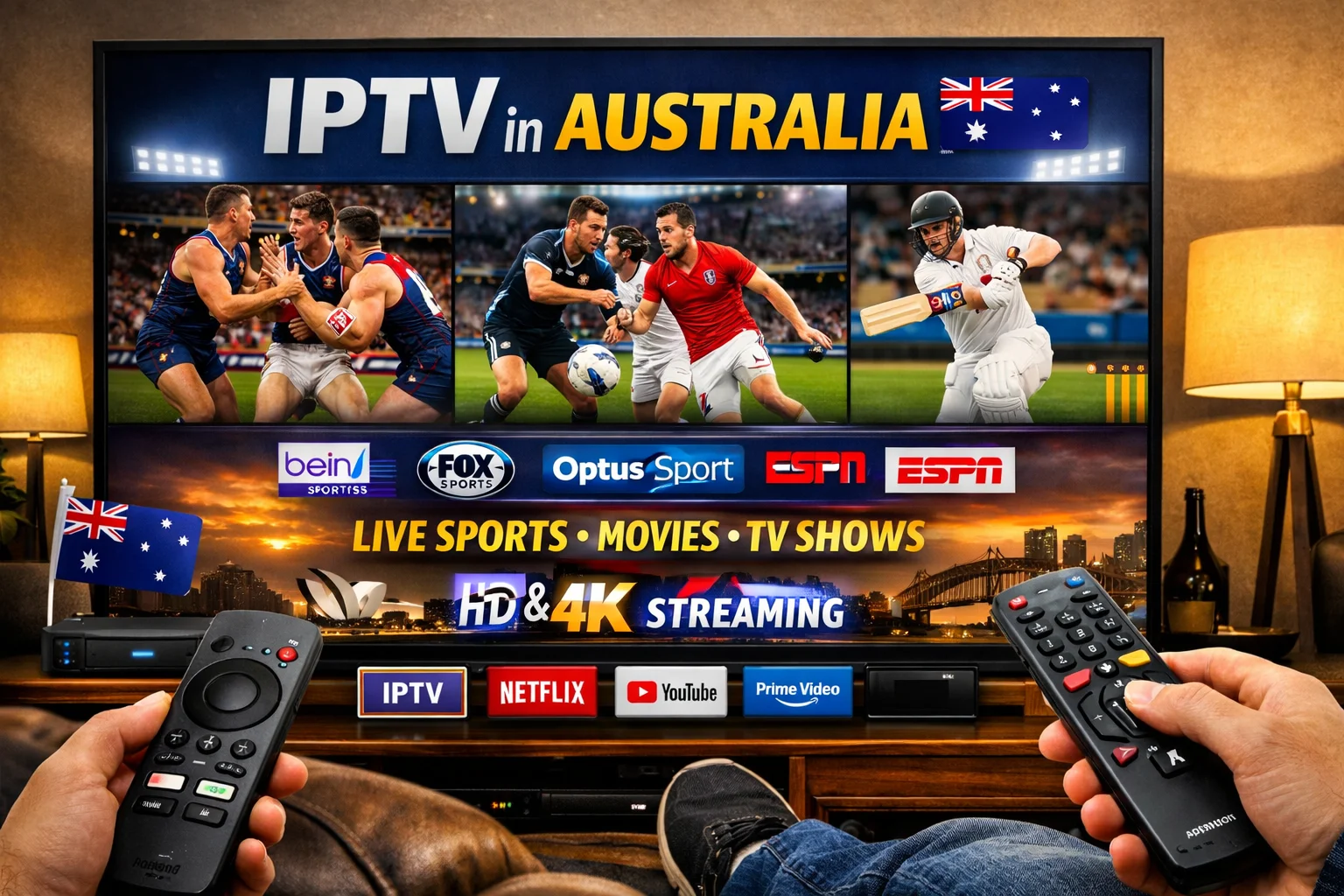
IPTV Australia 2026 has one of the highest rates of cord-cutting in the developed world. With pay television costs continuing to rise, Foxtel subscriptions becoming increasingly difficult to justify, and the quality of IPTV services reaching new heights, more Australians than ever are making the switch to internet-delivered television. Whether you’re in Sydney, Melbourne, Brisbane, Perth, or a regional area, IPTV in 2026 offers a compelling, cost-effective alternative to traditional pay TV — with more channels, better flexibility, and a fraction of the monthly cost.
This guide covers everything Australians need to know about IPTV: how it works, what content you can access, which devices to use, how to set it up, and — most importantly — what to look for in a trusted IPTV provider in Australia. We also cover the legal landscape and what questions to ask before handing over your money.
What Is IPTV and How Does It Work in Australia?
IPTV stands for Internet Protocol Television. Instead of receiving TV signals through a cable, antenna, or satellite dish, IPTV delivers television content over your broadband internet connection. A subscription gives you access to a list of live channels and often a video-on-demand library, delivered in real time to any compatible device in your home.
In Australia, IPTV has taken on particular significance because of the country’s geography. Traditional broadcast infrastructure has always struggled to deliver consistent quality across Australia’s vast distances, and regional Australians have historically been underserved by free-to-air and pay television alike. IPTV bypasses this entirely — as long as you have a broadband connection (and with the NBN now reaching most of Australia), you can access the same content quality as someone in inner-city Melbourne.
For Australians, IPTV typically means one of two things: legal over-the-top (OTT) services like Kayo Sports, Binge, Stan, and 9Now, or third-party IPTV subscriptions that deliver a wider range of channels — including international content, live sports, and pay channels — through M3U playlists and dedicated apps.
This guide focuses primarily on third-party IPTV subscriptions, which offer the most comprehensive channel selection and represent the main alternative to traditional Foxtel and cable television.
Why Australians Are Switching to IPTV
The numbers tell the story clearly. Foxtel’s subscriber base has been declining for years, while streaming and IPTV adoption continues to grow. There are several strong reasons why Australians are making the switch.
Cost Savings
A full Foxtel package with sports can cost AU$100 to $150 per month or more. A comprehensive IPTV subscription offering the same channels — and often many more — typically costs AU$15 to $40 per month. For a household that has been paying Foxtel prices for years, switching to IPTV can save thousands of dollars annually.
Flexibility
IPTV subscriptions are typically month-to-month with no lock-in contracts. Unlike Foxtel, which has historically required 12 or 24-month commitments, IPTV lets you subscribe, pause, or cancel whenever you like. This flexibility is particularly valued by sports fans who want coverage during the AFL season or NRL finals but don’t want to pay for twelve months of television.
Device Freedom
IPTV works on virtually any screen: your television, laptop, tablet, smartphone, or even a projector. One subscription can be used across multiple devices simultaneously, making it ideal for households where different family members want to watch different content at the same time.
Content Breadth
Quality IPTV services don’t just replicate what Foxtel offers — they exceed it. International channels, foreign language content, overseas sports leagues, and content from the UK, US, Europe, and Asia are all available through comprehensive IPTV packages. For multicultural Australian households, this is a significant advantage over traditional pay TV.
What Channels Are Available on Australian IPTV?
A well-rounded Australian IPTV package covers every major content category.
Australian Free-to-Air Channels
All major Australian free-to-air networks and their sub-channels are standard inclusions. This means Seven Network, Seven TWO, 7mate, 7flix, 9Network, 9Gem, 9Go!, 9Life, Ten Network, 10 Bold, 10 Peach, ABC1, ABC2, ABC Kids, ABC News, SBS, SBS Food, SBS World Movies, NITV, and more. Having these channels in an IPTV app alongside pay channels and international content creates a unified viewing experience rather than switching between antenna TV and streaming apps.
Sports — The Big Draw for Australian IPTV
Sport is the primary reason most Australians consider IPTV, and it’s where quality providers deliver the most value.
Fox Sports channels (Fox Sports 1, 2, 3, 4, and 5) cover the AFL, NRL, A-League, Super Rugby, tennis, cricket, and more. Fox Cricket is essential during the Australian cricket season, covering Test matches, ODIs, and the Big Bash League. Kayo-equivalent sports content through IPTV means you can follow every code without separate subscriptions.
International sports is where IPTV goes beyond what any Australian pay TV service offers. Premier League football, La Liga, Serie A, Bundesliga, Champions League, NBA, NFL, MLB, Formula 1, MotoGP, UFC, WWE, and boxing are all available through comprehensive IPTV sports packages. For Australian sports fans who follow international leagues, IPTV is genuinely transformative.
beIN Sports channels, ESPN Australia, and Sky Racing are also commonly included in premium Australian IPTV packages, covering thoroughbred racing, harness racing, and greyhound racing alongside the full suite of international sports.
Entertainment and Drama
Australian IPTV services include the full range of Foxtel entertainment channels: FOX8, FOX Showcase, FOX Comedy, Lifestyle, and Arena. Premium US content channels — HBO, Showtime, AMC, FX, and Starz — are frequently included, meaning you can watch the latest American prestige drama the same night it airs in the US rather than waiting for Australian release schedules.
BBC channels including BBC First, BBC Earth, and BBC World News are standard in quality packages, satisfying Australian audiences’ strong appetite for British content. Sky News Australia, Sky News UK, CNN International, Al Jazeera, France 24, and Deutsche Welle provide comprehensive international news coverage.
Kids and Family
Disney Channel, Disney Junior, Nickelodeon, Nick Jr., Cartoon Network, and ABC Kids are all typically available, making IPTV a genuine family television solution rather than just an adult-oriented streaming alternative.
International and Multicultural Channels
Australia’s multiculturalism is one of the country’s defining characteristics, and IPTV reflects this beautifully. Arabic, Chinese, Hindi, Italian, Greek, Vietnamese, Korean, and Filipino channels are available through comprehensive IPTV packages, serving Australia’s diverse communities in ways that Foxtel and free-to-air television have never adequately managed.
Best Devices for Australian IPTV
IPTV works across a wide range of devices that are readily available in Australia.
Amazon Fire TV Stick
The Amazon Fire TV Stick — particularly the Fire TV Stick 4K and 4K Max — is the most popular IPTV device among Australian users. It’s available from Amazon Australia, JB Hi-Fi, and Harvey Norman, making it easily accessible. The Fire TV platform fully supports TiviMate, IPTV Smarters Pro, and other leading IPTV players, and the device is straightforward to set up even for non-technical users.
Android TV Boxes
Android TV boxes offer more flexibility and power than streaming sticks. The Nvidia Shield TV Pro is the premium choice, delivering 4K HDR performance, excellent processing power, and support for Dolby Vision and Dolby Atmos. More affordable options like the Xiaomi Mi Box S and various generic Android TV boxes provide solid performance at lower price points and are available through Australian retailers and online.
Google Chromecast with Google TV
The Chromecast with Google TV runs a full Android TV-based operating system and supports IPTV apps natively. At a mid-range price point and available widely in Australia, it’s a clean and user-friendly option for households already in the Google ecosystem.
Smart TVs
Most modern Samsung, LG, Sony, Hisense, and TCL smart TVs sold in Australia support IPTV applications. Samsung’s Tizen OS and LG’s webOS have growing IPTV app ecosystems. For older smart TVs without app support, connecting an HDMI streaming stick transforms any television into an IPTV-capable device instantly.
Apple TV 4K
For households in the Apple ecosystem, Apple TV 4K supports several IPTV applications through the App Store, including IPTV Smarters. Its seamless integration with iPhones, iPads, and Macs makes it a natural choice for Apple-heavy households.
How to Set Up IPTV in Australia
Setting up IPTV in Australia takes less than fifteen minutes from start to finish.
Step 1: Choose a Provider and Subscribe
This is the most important step and covered in detail in the next section. Choose a provider that offers a free trial, confirm the channel selection meets your needs, and subscribe.
Step 2: Get Your Credentials
After subscribing, your provider will give you either an M3U URL (a web address that contains your channel playlist) or Xtream Codes credentials — a server URL, username, and password. Save these details as you’ll need them to configure your player.
Step 3: Download an IPTV Player
TiviMate is the best IPTV player available for Android and Fire TV devices. Download it from the Google Play Store or Amazon App Store. For iOS, IPTV Smarters Pro is available from the App Store. For computers, VLC Media Player handles M3U playlists natively and is free.
Step 4: Enter Your Credentials
Open TiviMate and select Add Playlist. Enter your M3U URL or Xtream Codes credentials. The app will load your full channel list automatically.
Step 5: Set Up Your EPG
A good Electronic Program Guide makes IPTV feel like a proper TV experience. Most providers supply an EPG URL alongside your credentials — enter this in TiviMate’s settings to populate your channel guide with Australian and international program schedules.
Step 6: Optimize Your Settings
Increase TiviMate’s buffer size to 5,000–10,000KB in the player settings to absorb brief network fluctuations. If available, connect your device via Ethernet rather than Wi-Fi. Configure QoS on your router to prioritize your IPTV device if your household has heavy concurrent internet usage.
What to Look for in a Trusted Australian IPTV Provider
This is where many Australian IPTV users go wrong. The market has dozens of providers ranging from excellent to completely unreliable, and choosing poorly means wasted money and a frustrating viewing experience. Here is exactly what to look for.
Free Trial Before Payment
Any reputable IPTV provider will offer a free trial of at least 24 hours — ideally 48 hours — before asking for payment. This is non-negotiable. A trial allows you to test stream quality, confirm your required channels are available and working, evaluate server stability during peak hours, and assess the EPG accuracy before committing money. If a provider refuses to offer any form of trial, treat this as a serious red flag.
Australian and International Server Infrastructure
For Australian users, server location matters significantly. A provider with servers hosted in Australia or nearby Singapore and Asia-Pacific locations will deliver lower latency and more stable streams than one running entirely from European or American infrastructure. Ask your provider where their servers are located before subscribing.
HD and 4K Stream Quality
In 2026, HD (1080p) should be the baseline for every channel in an IPTV package, not a premium add-on. Quality providers offer HD streams across all major channels and 4K streams for supported content and sports broadcasts. If a provider only offers SD quality at standard pricing, look elsewhere.
Uptime and Redundancy
Server downtime is the enemy of live sports viewing. A trusted provider maintains multiple redundant streams for popular channels, ensuring that if one server experiences issues, your stream automatically switches to a backup. Ask providers directly about their uptime guarantee and redundancy setup. Look for providers advertising 99.9% uptime with automatic failover.
Responsive Customer Support
When something goes wrong — and occasionally it will — you need to be able to reach your provider quickly. Quality IPTV providers offer support via live chat, email, or a ticketing system, with response times measured in hours, not days. Test the support before subscribing by sending a pre-sale question and evaluating how quickly and helpfully they respond.
Simultaneous Connections
Most household IPTV users want to watch on more than one device at a time. Check how many simultaneous connections your subscription includes — quality providers typically offer 2 to 5 connections per subscription. If you have a family with multiple TVs and devices, confirm the connection limit suits your needs before subscribing.
Community Reputation
Before subscribing to any Australian IPTV provider, research their reputation in the IPTV community. Australian IPTV forums, Reddit communities (particularly r/IPTV and Australian streaming subreddits), and Facebook groups dedicated to cord-cutting in Australia are valuable sources of real user feedback. Look for providers with consistently positive long-term reviews, not just recent promotional activity.
Payment Security
Use payment methods that offer purchase protection when subscribing to IPTV services. PayPal is widely accepted by reputable providers and offers dispute resolution if the service fails to deliver. Be cautious of providers that only accept cryptocurrency or non-refundable payment methods — this removes your ability to seek a refund if the service is unsatisfactory.

Red Flags to Avoid When Choosing an Australian IPTV Provider
Just as important as knowing what to look for is knowing what to avoid.
No Trial Offered
As mentioned, any provider unwilling to offer even a short free trial is a red flag. It suggests the provider knows their service won’t impress on first experience.
Unrealistic Pricing
While IPTV is significantly cheaper than Foxtel, suspiciously low pricing — AU$5 or less per month for a supposedly comprehensive service — often indicates poor server quality, limited channels, or an unreliable operation that may disappear without warning.
No Customer Support Contact Information
If a provider’s website has no clear contact information, no support channel, and no way to reach a human being before subscribing, assume that support will be non-existent when you need it.
Overpromising Channel Counts
Providers advertising “10,000 channels” or “50,000 VOD titles” are often padding their numbers with non-functional, duplicate, or extremely low-quality streams. A provider offering 2,000 well-curated, reliably streaming channels is worth far more than one offering 10,000 channels where half don’t work.
No Social Proof or Online Presence
Trusted providers have verifiable online presences — forums where users discuss their service, review platforms with real feedback, and active community engagement. A provider that exists only through a single website with no external validation should be approached with caution.
Internet Speed Requirements for Australian IPTV
Australia’s NBN network has brought broadband connectivity to most of the country, but plan speeds vary widely and directly affect IPTV performance.
For a single HD IPTV stream, an NBN25 (25 Mbps) plan is the absolute minimum, but NBN50 (50 Mbps) is strongly recommended to leave headroom for other household internet usage. For 4K IPTV, NBN100 or higher is the practical standard — 4K streams require 25 to 40 Mbps for the stream alone, and most Australian households have multiple devices competing for bandwidth simultaneously.
NBN50 and NBN100 plans are now the most common tiers among Australian households and are broadly available through providers like Aussie Broadband, Superloop, Telstra, and Optus. If you’re on NBN25 and experiencing IPTV buffering, upgrading your NBN plan is often the single most impactful improvement you can make.
Evening congestion remains an issue on some NBN connections, particularly in areas served by FTTN (fiber to the node) infrastructure. If you experience buffering specifically during peak evening hours (7pm to 10pm), this is likely NBN congestion rather than an IPTV provider issue. Switching to a higher-quality NBN provider — Aussie Broadband consistently ranks highest for Australian evening speeds — can make a significant difference.
Final Thoughts
IPTV in Australia has reached a maturity point where it genuinely rivals traditional pay television in content breadth, stream quality, and reliability — while costing a fraction of what Foxtel charges. For Australians who watch live sport, follow international leagues, want access to premium international drama, or simply want to stop paying for dozens of channels they never watch, IPTV in 2026 is the most compelling television option available.
The key to a great Australian IPTV experience is choosing the right provider. Take advantage of free trials, test during peak sports and viewing hours, verify the specific channels you care about most are available and working, and research provider reputation through Australian IPTV communities before committing to a subscription.
With a reliable NBN connection, a quality Android streaming device, TiviMate as your player, and a trusted IPTV provider, you’ll have a television setup that matches or exceeds anything Foxtel has ever offered — at a price that makes the monthly bill feel almost too good to be true.
The cord has been cut. The streaming era is fully here. And for Australians, IPTV is leading the way.